Biochemical Summary
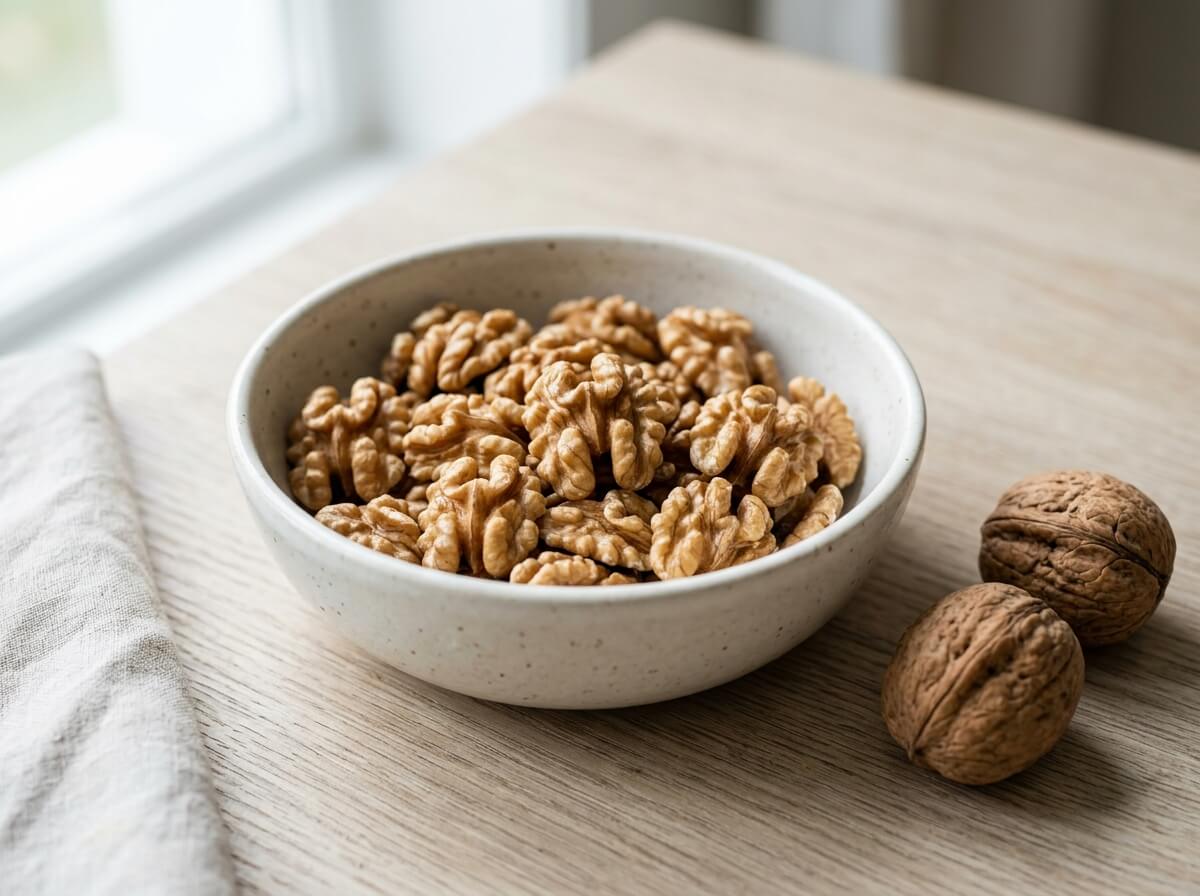
Chia seeds and walnuts are extraordinary health foods, but they are not bio-identical replacements for marine EPA and DHA. Plant omega-3s consist of Alpha-Linolenic Acid (ALA). To be used for neuronal membrane fluidity and anti-inflammatory eicosanoid signaling, ALA must undergo sequential elongation and desaturation inside the liver. Because human enzymatic conversion to DHA is exceptionally low (typically under 1%), relying exclusively on seeds may leave active tissue DHA levels sub-optimal unless paired with direct algal DHA or intentional dietary optimization.
The Molecular Hierarchy: ALA vs. EPA vs. DHA
| Fatty Acid Molecule | Carbon Structure | Primary Dietary Sources | Primary Biological Function |
|---|---|---|---|
| Alpha-Linolenic Acid (ALA) | 18:3n-3 (18 carbons, 3 double bonds) | Chia seeds, walnuts, ground flaxseeds, hemp seeds | Energy oxidation via beta-oxidation (up to 70% burned for ATP); cardiovascular anti-arrhythmic substrate |
| Eicosapentaenoic Acid (EPA) | 20:5n-3 (20 carbons, 5 double bonds) | Wild salmon, sardines, mackerel, marine algae | Substrate for series-3 prostaglandins and series-5 leukotrienes; potent systemic anti-inflammatory signaling |
| Docosahexaenoic Acid (DHA) | 22:6n-3 (22 carbons, 6 double bonds) | Fatty cold-water fish, egg yolks (pastured), algal oil | Constitutes over 50% of total polyunsaturated fatty acids in neuronal membranes and 90% in retinal photoreceptors |
The conversion of ALA to EPA and DHA requires a coordinated enzymatic cascade:
$\text{ALA (18:3)} \xrightarrow{\Delta^6\text{-desaturase}} \text{SDA (18:4)} \xrightarrow{\text{elongase}} \text{ETA (20:4)} \xrightarrow{\Delta^5\text{-desaturase}} \text{EPA (20:5)} \xrightarrow{\text{elongase/}\beta\text{-ox}} \text{DHA (22:6)}$
This biochemical pathway encounters two major physiological obstacles:
- Enzyme Competition: $\Delta^6$-desaturase (encoded by the FADS2 gene) is the exact same enzyme used to desaturate dietary Omega-6 Linoleic Acid (LA). When the ratio of dietary Omega-6 to Omega-3 exceeds 10:1 (common in Western diets filled with corn, soybean, and sunflower oils), the enzyme is overwhelmed by Omega-6 substrates, suppressing ALA conversion by up to 70%.
- Sexual Dimorphism in Conversion: Women of reproductive age exhibit significantly higher conversion of ALA to DHA (approx. 9%) compared to adult males (under 1%). This is hormonally mediated by 17$\beta$-estradiol to ensure adequate maternal DHA delivery to fetal and infant neural development.
Omega-3 Density in Key Whole Foods (Per 100 g)
| Food Item | Serving State | ALA Content (g) | EPA + DHA Content (g) | Omega-6:Omega-3 Ratio |
|---|---|---|---|---|
| Chia Seeds | Raw Dry | 17.8 g | 0.0 g | 0.3 : 1 (Ideal) |
| English Walnuts | Raw Shelled | 9.08 g | 0.0 g | 4.2 : 1 |
| Wild Atlantic Salmon | Cooked / Baked | 0.14 g | 2.15 g | 0.1 : 1 |
| Algae Oil (Pure) | Liquid Oil | 0.0 g | 40.0 g – 50.0 g | Zero Omega-6 interference |
Because omega-3 fatty acids possess multiple delicate double bonds, they are exquisitely vulnerable to lipid peroxidation when exposed to ambient heat, light, and oxygen:
- Grind flaxseeds fresh: Whole flaxseeds have a thick outer seed coat that passes through the gut intact. Once ground into meal, store it in an opaque airtight glass container in the freezer. Ground flax kept at room temperature oxidizes within weeks, producing inflammatory lipid peroxides.
- Chia seeds are more stable: Chia seeds naturally contain potent lipophilic antioxidants (myricetin, quercetin, and chlorogenic acid) that stabilize its ALA lipids, allowing whole chia to remain shelf-stable at room temperature for up to two years.