Methodological Summary
Nutrient density per calorie is the ratio of beneficial micronutrients to gross energy. Instead of evaluating how much nutrition a food provides per 100 grams of weight (which is easily diluted by water content or inflated by dehydration), measuring per 100 kilocalories answers a vital metabolic question: "For every unit of energy I consume, how much cellular nourishment do I receive?" FoodAlt transparently scores and ranks whole foods using this exact principle.
The Mathematics of Nutrient Profiling: The FoodAlt NDI Algorithm
Historically, nutritional profiling models—ranging from Dr. Joel Fuhrman's Aggregate Nutrient Density Index (ANDI) to the French SAIN/LIM system and the Hannisdal Nutrient-Rich Foods (NRF9.3) index—have attempted to distill complex food matrices into a single numeric score. While useful, earlier algorithms suffered from mathematical distortion: a food containing 2,000% DV of vitamin A would receive an artificially colossal score, even if it lacked iron, calcium, protein, or zinc.
FoodAlt developed the Nutrient Density Index (NDI) to solve this distortion through nutrient threshold capping and multi-nutrient aggregation:
For each whole food record in our verified USDA database, FoodAlt evaluates 14 qualifying nutrients: Protein, Dietary Fiber, Vitamin A, Vitamin C, Vitamin E, Vitamin K, Folate (B9), Vitamin B12, Calcium, Iron, Magnesium, Potassium, Zinc, and Selenium.
The standardized formula is calculated as follows:
- Normalize to 100 kcal: For each nutrient $i$, calculate concentration per 100 kcal: $C_{i, 100 ext{kcal}} = rac{N_i}{ ext{Calories}} imes 100$.
- Calculate % Daily Value: Divide by the FDA/NIH Daily Value: $ ext{DV}_i = rac{C_{i, 100 ext{kcal}}}{ ext{RDA}_i} imes 100$.
- Apply 100% Saturation Cap: To prevent extreme single-nutrient bias, each nutrient contribution is capped: $ ext{Score}_i = min( ext{DV}_i, 100)$.
- Composite Score: $ ext{NDI} = rac{1}{14} sum_{i=1}^{14} ext{Score}_i$.
How Different Food Categories Compare on the NDI Scale
| Food Item | Food Group | Calories / 100 g | NDI Score (0–100) | Key Contributing Micronutrients |
|---|---|---|---|---|
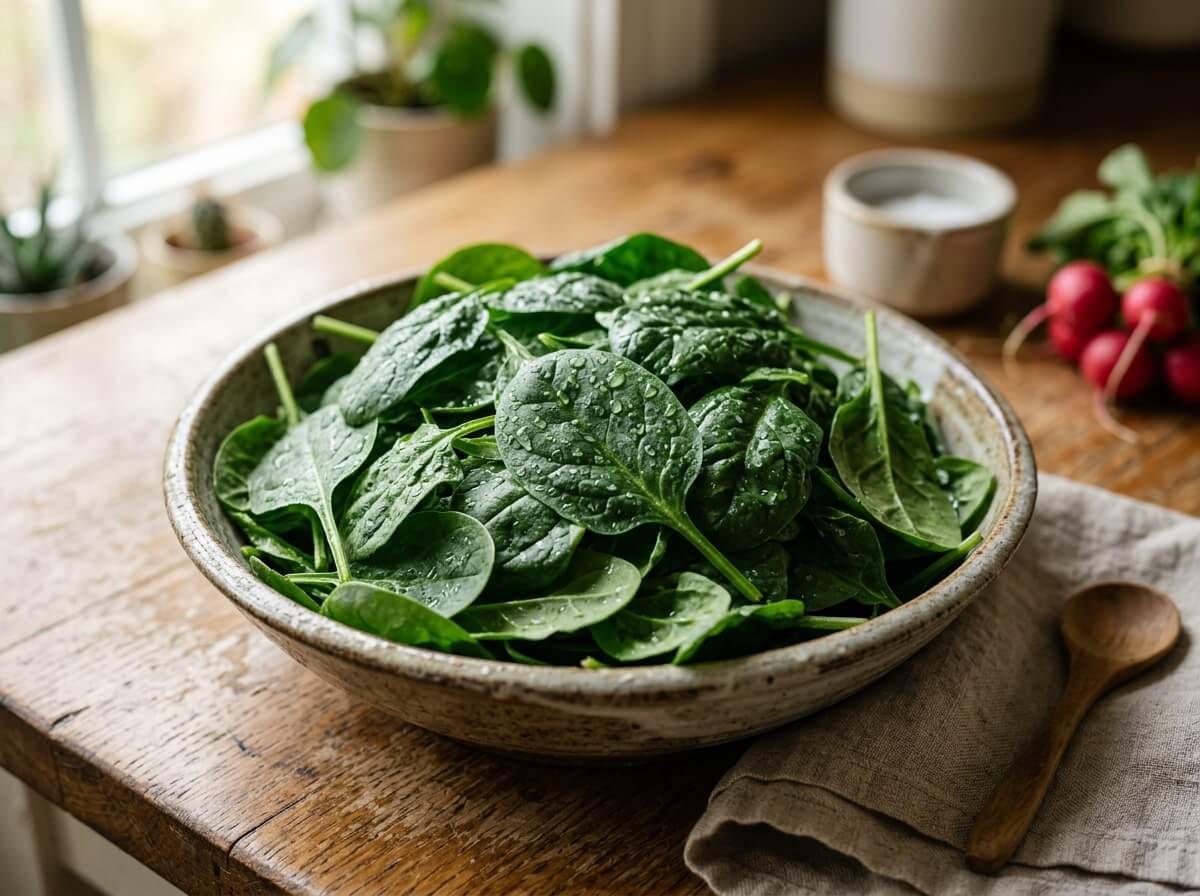
| Raw Spinach | Leafy Greens | 23 kcal | 94 / 100 | Vitamin K, Vitamin A, Folate, Vitamin C, Magnesium, Iron |
| Broccoli | Cruciferous | 34 kcal | 88 / 100 | Vitamin C, Vitamin K, Folate, Fiber, Potassium |
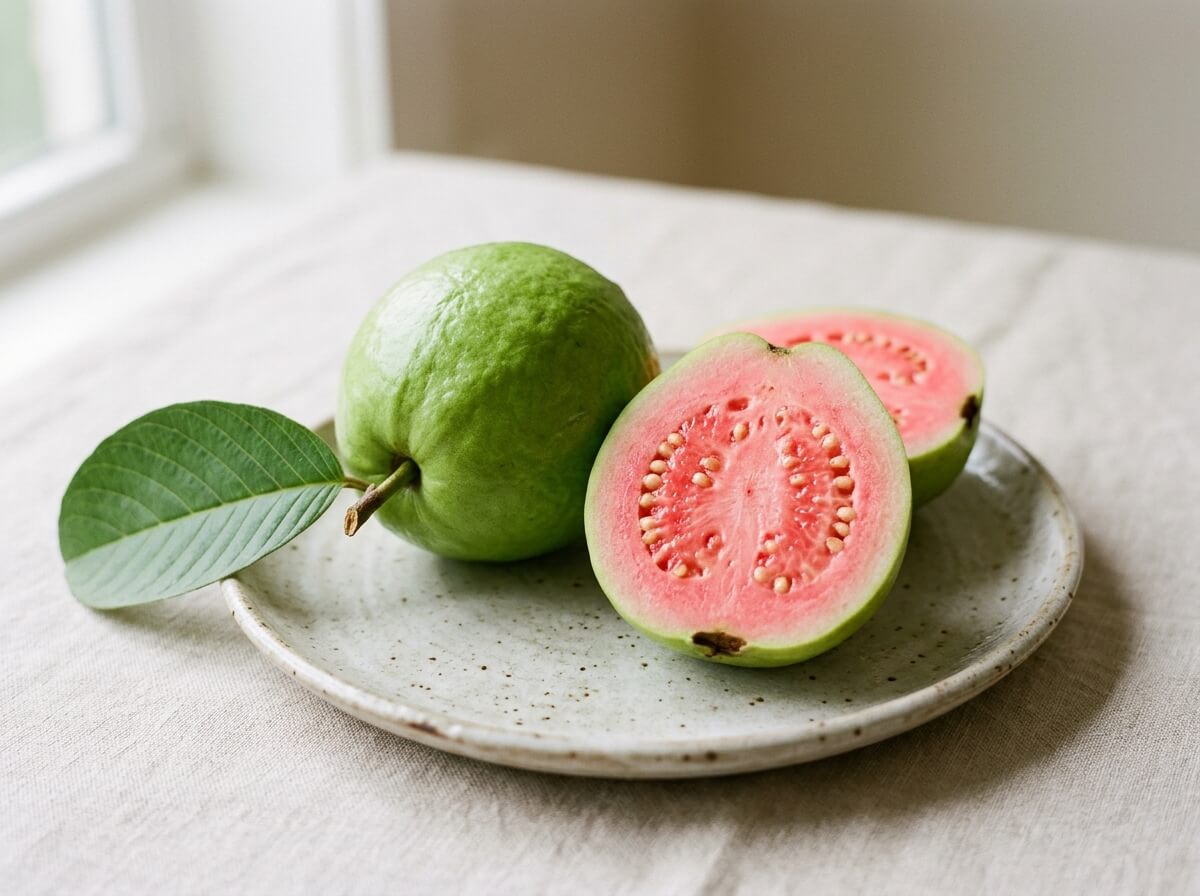
| Raw Guava | Fruits | 68 kcal | 79 / 100 | Vitamin C, Fiber, Potassium, Folate, Copper |
| Firm Tofu | Plant Protein | 83 kcal | 72 / 100 | Protein, Calcium, Iron, Zinc, Magnesium |
| Wild Salmon | Fish & Seafood | 182 kcal | 64 / 100 | Protein, Vitamin B12, Selenium, Potassium, Vitamin D |
| Raw Almonds | Nuts & Seeds | 579 kcal | 42 / 100 | Vitamin E, Magnesium, Fiber, Protein, Copper |
| White Rice | Refined Grains | 130 kcal | 14 / 100 | Starch carbohydrates, low trace minerals |
The Nutrient Density Paradox: Why Low-NDI Foods Still Matter
A frequent misunderstanding of nutrient-density scoring is assuming that one should only consume foods with NDI scores above 80. If an individual ate only raw spinach, kale, and watercress, they would achieve tremendous vitamin K and carotenoid intakes, but would suffer severe caloric starvation and essential fatty acid deficiency.
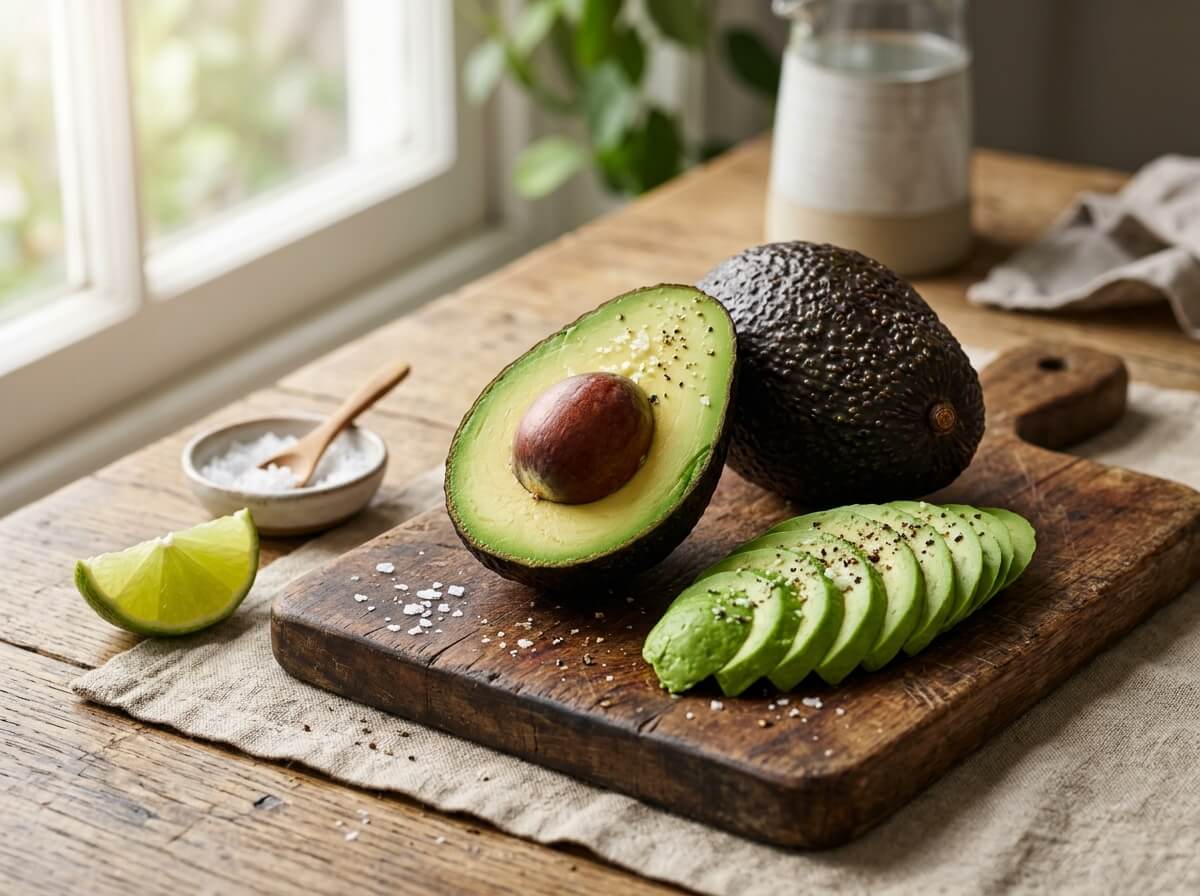
Foods like extra virgin olive oil, walnuts, and avocados score lower on a strict per-calorie NDI index because lipids provide 9 kcal per gram (compared to 4 kcal/g for protein and carbs). Yet dietary fats are mandatory for life: they constitute neuronal myelin sheaths, form the phospholipid bilayers of every cell, and are biologically required to dissolve and absorb the very fat-soluble vitamins (A, D, E, K) found in leafy greens.
To extract maximum nutritional value from high-NDI vegetables, always prepare them with a source of healthy fat:
- Carotenoid Absorption: Beta-carotene in raw carrots and spinach has less than 5% absorption efficiency when consumed without lipids. Adding just 5–10 g of healthy fat (e.g. olive oil or sliced avocado) increases intestinal micelle formation and carotenoid absorption by over 400%.
- Sulforaphane Activation: Lightly steaming broccoli or kale for 3–4 minutes preserves active myrosinase enzymes, maximizing anti-inflammatory isothiocyanate formation compared to prolonged boiling.